
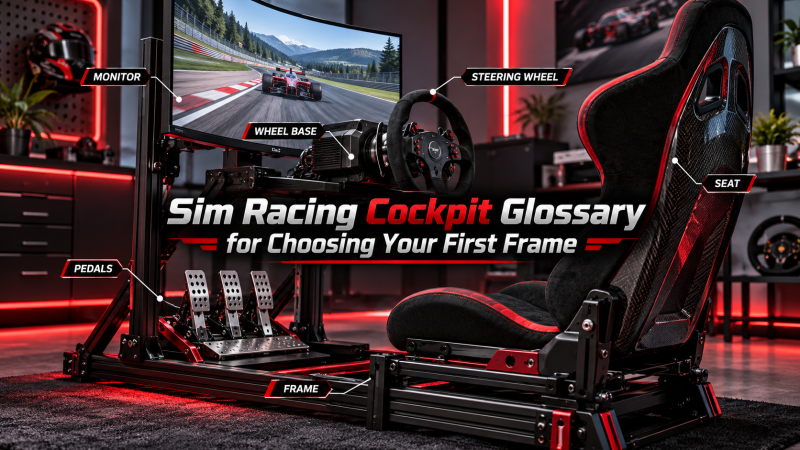
Sim Racing Cockpit Glossary for Choosing Your First Frame
Shopping for a sim racing cockpit quickly brings unfamiliar words, from aluminum profile sizes to side mounts, flex, and tactile transducers…
SUGGESTED
TRENDING NOW
sim-racing
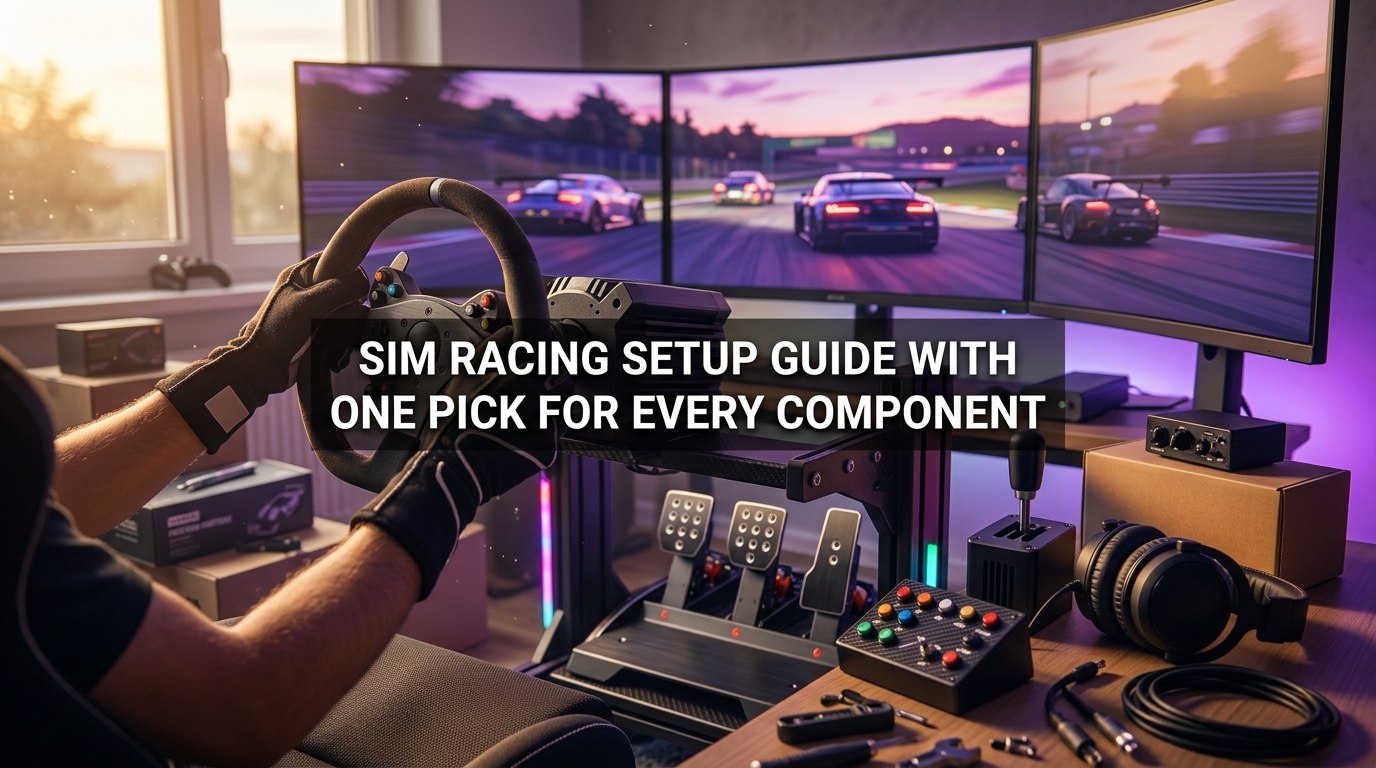
Building a sim racing setup can feel overwhelming, with dozens of wheels, pedals, cockpits, and displays competing for attention. The easiest way through the noise is to choose one strong option per category, then upgrade only when you know what you need. This guide picks a standout wheelbase, pedal set, cockpit, display option, and accessories, explaining who each suits and how the pieces fit together into a racing simulator setup that grows with you.
Before choosing hardware, confirm which platform you race on. PC supports nearly every wheel and pedal set, while PlayStation and Xbox require hardware specifically licensed for those consoles. Choosing a compatible ecosystem first prevents expensive mistakes and makes future upgrades easier.
Budget planning matters too, because every racing simulator setup has hidden costs. A complete sim racing setup includes a wheelbase, wheel rim, pedals, a mount or cockpit, and a display. Spreading your budget across these parts usually delivers a better experience than spending most of it on a single powerful wheelbase.
The wheelbase is the heart of any sim racing setup. Direct drive wheelbases connect the motor directly to the wheel shaft, delivering detailed, responsive force feedback. Once expensive, they now start at accessible prices. Options such as the Moza R5, rated at 5.5 Nm, and the Fanatec CSL DD, rated at 5 Nm with an optional boost to 8 Nm, are popular PC starting points. For console players, Logitech's RS50 brought an 8 Nm direct drive base compatible with PlayStation or Xbox depending on the version.
For a first sim racing setup, our pick is an entry-level direct drive base in the 5 to 8 Nm range. That strength is enough to feel tire grip and weight transfer clearly without overwhelming a desk mount. Gear-driven wheels like the Logitech G923 remain a budget option, but direct drive offers a noticeably richer experience.
If you upgrade only one part of your sim racing setup, make it the pedals. A load cell brake measures pressure rather than travel, much like a real car's brake, which makes your braking consistent lap after lap. Most drivers find they become faster within days of switching.
Sets such as the Fanatec CSL Pedals with the load cell kit or Moza's SR-P pedals with a load cell brake are common choices. Our pick is any three-pedal or two-pedal set with a load cell brake from your wheelbase's ecosystem, which keeps software and compatibility simple.
A sim racing setup is only as solid as its mount. Desk clamps work for starting out, but stronger wheelbases and load cell pedals quickly push a desk to its limits. A dedicated cockpit keeps everything rigid and positioned correctly. Foldable stands save space, tube-frame seats from brands such as Next Level Racing and Playseat offer an easy step up, and aluminum profile rigs provide the most stability and adjustability.
Our pick for most players is an aluminum profile cockpit if space allows, since it handles future upgrades without flexing. If you live in a smaller home, a sturdy wheel stand is the practical alternative that can be tucked away after each session.
In a sim racing setup, your display shapes immersion more than any other component. A single large screen or ultrawide monitor is the simplest choice and works well for console racing. Triple monitors give PC racers natural peripheral vision for side-by-side battles, while VR headsets offer unmatched depth perception at a lower desk footprint.
Our pick is a single ultrawide for most beginners, then triples or VR once you are committed. Position the screen as close as possible behind the wheel and set the in-game field of view correctly, which improves your sense of speed and braking points.
Even the best hardware feels wrong if your seating position is off. Your arms should be slightly bent when holding the wheel at the top, your knees should not lock when the pedals are fully pressed, and the screen should sit at eye level directly behind the wheel. Small adjustments here often improve lap times more than an expensive upgrade.
Comfort also matters for longer races. A supportive seat, a firm pedal deck that does not slide, and cable management that keeps wires away from your feet all reduce fatigue. Treat ergonomics as part of your racing sim setup, not an afterthought, and revisit them whenever you add a new component.
Category
Our pick
Why
Wheelbase
Entry direct drive, 5 to 8 Nm
Detailed feedback at accessible prices
Pedals
Load cell brake set
Consistent braking and faster laps
Cockpit
Aluminum profile rig or sturdy stand
Rigidity for upgrades or space saving
Display
Single ultrawide, later triples or VR
Simple start with room to grow
Accessories
Shifter or handbrake as needed
Only for disciplines that use them
Accessories are the final layer of a sim racing setup. Sequential or H-pattern shifters and handbrakes add realism for rally and drifting, but they are optional for GT and formula racing. On PC, free tools such as SimHub let you add dashboards and telemetry. Spend on these only after the core components feel right.
1. Confirm platform compatibility before buying anything.
2. Prioritize pedals and a solid mount over raw wheelbase power.
3. Upgrade one component at a time based on real limitations.
4. Tune force feedback and field of view carefully in each sim.
A great sim racing setup is built step by step and not bought all at once. Start with an entry direct drive base, load cell pedals, a stable mount, and a sensible display, then add accessories as your driving improves. Each upgrade should solve a problem you have actually felt. Which component will you start with?
sim-racing
Shopping for a sim racing cockpit quickly brings unfamiliar words, from aluminum profile sizes to side mounts, flex, and tactile transducers…
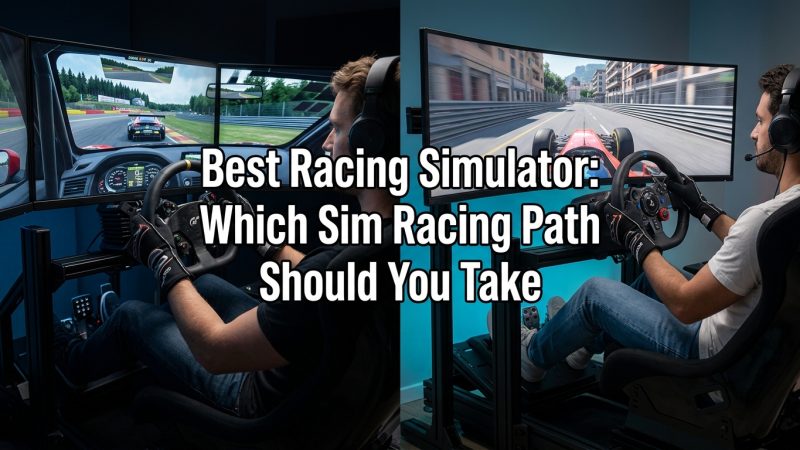
Sim racing has never offered more choice, and that makes the first step harder. The best racing simulator for one driver can be the wrong fit for…

Racing games range from colorful kart battles to painstakingly realistic recreations of real circuits. So what is sim racing, and how is it different…