
Racing Sim Rig Review: Which Setup Is Worth It by Budget
A racing sim rig turns racing games into something close to real driving. This review splits rigs into three budget levels, from beginner kits to mid-range setups with direct drive wheelbases and…
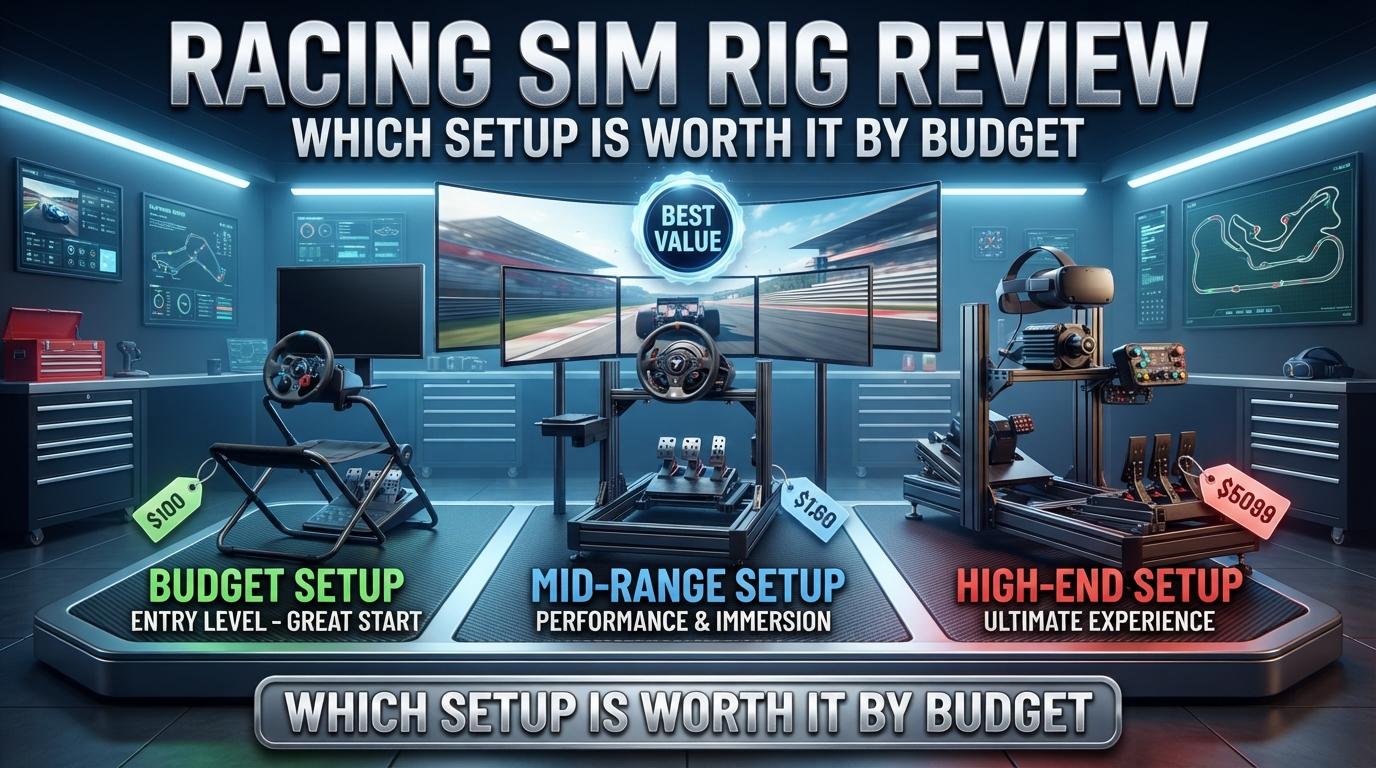
A racing sim rig turns racing games into something close to real driving. This review splits rigs into three budget levels, from beginner kits to mid-range setups with direct drive wheelbases and serious enthusiast builds, comparing wheels, pedals, and cockpits so you can decide which setup offers the best value for your driving style and the time you plan to spend on track.
Key Takeaways
A good-value racing sim rig starts with a solid wheelbase and pedals
Direct drive bases feel clearly more precise than gear or belt systems
A rigid cockpit matters more as torque increases
Upgrading one part at a time beats buying everything at once
The Parts of a Racing Sim Rig
A rig has four main parts: the wheelbase that generates force feedback, the wheel rim, the pedals, and the cockpit or frame that holds everything together. Accessories such as shifters, handbrakes, and monitor stands add more. The value of a racing sim rig depends on balancing these parts rather than overspending on a single one.
Rigs Compared by Budget
Level
Wheelbase
Pedals
Cockpit
Best for
Entry
Gear or belt driven, such as entry Logitech or Thrustmaster wheels
Potentiometer
Desk clamp or folding stand
Beginners trying it out
Mid
Low to mid torque direct drive, such as entry Moza or Fanatec bases
Load cell
Tube-frame or entry cockpit
Drivers getting serious
Enthusiast
High-torque direct drive
High-end load cell or hydraulic
Aluminum profile frame
Online racers seeking maximum realism
Entry Level: Try Before You Invest
Entry wheels use gears or belts to transmit force, delivering a basic driving feel far better than a gamepad. They clamp to a desk without a cockpit, suiting anyone testing whether they enjoy sim racing. The limitations are coarse force feedback and potentiometer brake pedals that make modulating braking difficult.
Mid-Range: The Best-Value Racing Sim Rig?
Many consider mid-range the sweet spot, since direct drive bases, which connect the wheel shaft directly to a motor, have become far more affordable in recent years. Brands such as Moza and Fanatec offer entry models with detailed force feedback, letting you clearly feel grip and slides. Paired with load cell brakes that measure pressure rather than pedal travel, braking control improves dramatically, which genuinely lowers lap times.
Note that direct drive bases produce more torque than entry kits, so a desk clamp may not be stable enough; plan for a sturdy cockpit or frame at the same time.
Enthusiast Level: Maximum Realism
Enthusiast rigs use high-torque direct drive bases, premium pedals, and rigid aluminum profile frames with fine adjustment. Some add motion systems or tactile transducers to simulate impacts. This level suits serious online racers or drivers using sims for training, but it demands significant budget, space, and more complex setup.
How Much Does the Cockpit Matter?
A rigid cockpit keeps your seat, wheel, and pedals positioned like a real car and prevents flex under hard braking or fast steering. Folding cockpits suit tight spaces, while aluminum profile frames suit drivers who want to customize and upgrade later. Choosing a sim racing cockpit that matches your wheelbase is as important as the base itself and is central to a stable racing sim rig.
A Racing Sim Rig and Your Living Space
Before buying a racing sim rig, measure your space carefully. A full cockpit needs roughly the footprint of a driver's seat plus pedal length, with extra room for displays. High-torque direct drive bases also transmit vibration through the floor, so apartment dwellers should consider anti-vibration mats. Plan cable management and USB ports too, since many devices must connect at once.
How Much Do Screens and Seating Position Matter?
Even great hardware underdelivers if your screen and seating are wrong. Placing the monitor close and at eye level, then matching the in-game field of view, helps you judge braking points and corner entries more accurately. Some drivers use triple screens or VR headsets for peripheral vision, which helps enormously in wheel-to-wheel racing. Setting your seat so knees and elbows bend slightly, as in a real race car, keeps you comfortable over long sessions and makes a racing sim rig feel far more realistic.
Small ergonomic details add up as well. A pedal base that does not slide, a wheel positioned at the right height, and a seat that supports your back all reduce fatigue, which means more consistent laps late in a race when concentration matters most.
How Should You Plan Upgrades?
A path many drivers recommend is to start with a basic wheel, upgrade to load cell brakes next for the biggest consistency gain, then move to a direct drive wheel and a rigid cockpit, and add accessories last. Planning your sim rig budget this way makes every purchase count and avoids retiring equipment too early.
Before buying, confirm that equipment supports your platform, since some wheelbases work only on PC or with specific consoles, and check that your main games, such as iRacing, Gran Turismo 7, or Assetto Corsa Competizione, officially support the hardware.
Software settings matter as much as hardware. Taking time to tune force feedback strength, rotation angle, and pedal curves for each game often transforms how a rig feels, so budget an evening for setup before judging any new part.
Joining a sim racing community or league is another great next step. Regular organized races, setup sharing, and feedback from experienced drivers help you improve faster than practicing alone, and they make every upgrade to your rig feel more worthwhile, since you can measure progress against real opponents week after week.
Most of all, enjoy the process of learning each track and car over time.
In short, the best-value racing sim rig depends on your budget and commitment. Entry kits are ideal for trying the hobby, mid-range direct drive setups with load cell pedals are the sweet spot for most drivers, and enthusiast rigs serve racers chasing maximum realism. Upgrade step by step, match your cockpit to your hardware, and check platform compatibility, and your lap times will improve noticeably.