
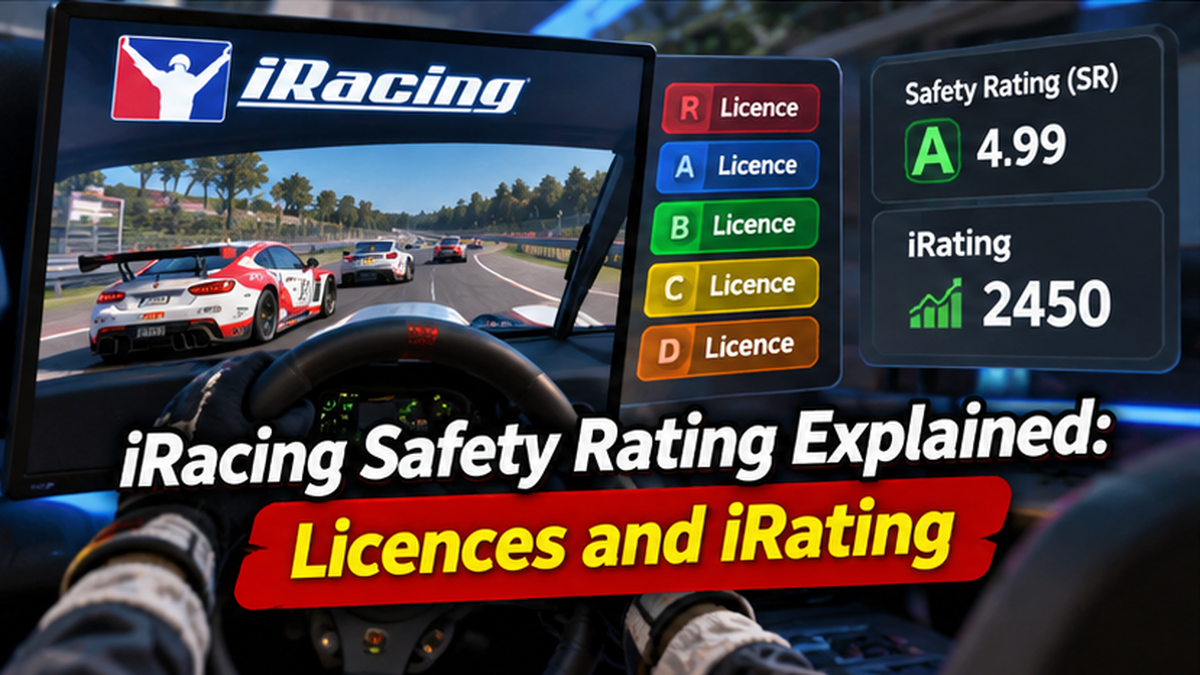
iRacing Safety Rating Explained: Licences and iRating
iRacing hides its progression behind three numbers: licence class, Safety Rating and iRating. New drivers often mix them up, then wonder why a fast race did not lead to a promotion. This guide explains how iRacing measures clean driving, how incident points work, how licence promotions happen, and how to climb without wrecking your Safety Rating along the way.
Key Takeaways
- iRacing Safety Rating measures how cleanly you drive, while iRating measures how well you finish against the field
- Incident points of 1x, 2x and 4x lower your Safety Rating, and clean laps raise it
- An iRacing licence promotion needs minimum participation plus enough Safety Rating, with a fast-track option above 4.00
- Clean, patient races teach more than aggressive ones, especially in Rookie series
What iRacing Safety Rating Measures
In iRacing, Safety Rating, usually shortened to SR, is a number between 0.00 and 4.99 that reflects how many incident points you typically earn compared with the number of corners you drive. Every iRacing member starts with a Rookie licence and an SR of 2.50. Finish sessions without incidents and the number rises; collect incidents and it falls.
SR is separate from your results. A driver who wins while crashing twice can lose SR, and a driver who finishes last without a single incident can gain it. That design is intentional, because iRacing wants public races full of people who can be trusted to race closely without wrecking each other.
How iRacing Incident Points Work
During a session you will see incident counts at the top of the screen. Incident points arrive in values of 1x, 2x and 4x, and no single incident can give you more than 4x. Going off the racing surface and losing control of the car earn points, and contact with walls or other cars costs more as it becomes more serious.
The iRacing system is described as no-blame. When two cars touch, every driver involved receives the same points, even if one clearly caused the contact. Single-car sessions such as Time Trials are weighted lower than races, so they affect SR much less. Only official, ranked sessions change your rating.
iRacing Licence Classes and Promotion
The iRacing licence ladder runs from Rookie to D, C, B and A. Each class unlocks faster cars and harder series, so the system protects new drivers from entering fields they are not ready for. To be promoted, you must complete a minimum participation requirement and have enough Safety Rating at the right moment.
At the end of each season, an SR of 3.00 or more promotes you if you met the participation requirement. Drivers between 2.00 and 3.00 keep their licence, and an SR below 2.00 at season end can lead to demotion. After any promotion, your SR is reduced by about 1.00, so you must keep driving cleanly to earn the next step.
Minimum Participation and Fast-Track Promotion
In iRacing, minimum participation means completing a set number of official races at your current licence level, often four, or only two at Rookie. Time trials can also count toward the requirement. This rule stops a lucky short streak from jumping you up the ladder.
An iRacing driver whose SR climbs above 4.00 after meeting participation can receive a fast-track promotion in the middle of a season. Some coaches say a focused rookie can leave the first licence in about five races, provided every race finishes with zero incident points. Treat that as an ideal, not a promise.
iRating: The Other Number
iRacing's iRating works like an Elo-style rating. It rises when you beat strong opponents and falls when you finish below expectations, and it has nothing to do with licence promotion. It is also tracked separately for each discipline, so your oval rating can differ from your road rating.
iRacing uses iRating to place drivers in races of similar skill, which keeps competition balanced. As a Rookie you have no precious rating to protect, so your priority is learning rather than finishing high.
How to Raise Your iRacing Safety Rating
In iRacing, SR gains come from clean corners. Because the system looks at incident points per corner, longer races at tracks with many turns are more forgiving than short sprints. A single mistake in a long race can be recovered, while one early incident in a short race can cost much more.
Practise before you race. Learn the layout, find reliable braking points and leave extra space in the first lap, where most incidents happen. If you start from the back, stay calm and avoid fighting for positions that will not change your result. A clean finish at the back still improves iRacing progress.
iRacing Mistakes That Hurt Your SR
Common iRacing mistakes include dive-bombing into braking zones, driving at full speed after a spin, and trying to rejoin the track without checking for traffic. Another is chasing wins in Rookie series, which punishes the impatient.
Spinning is not always a disaster. If you lose control, stay off the racing line, wait for traffic and then rejoin safely. Heavy braking in the middle of the pack can cause chain reactions that cost several drivers their SR, so brake early and predictably.
Choosing Series While You Climb
Pick series that match your tools and goals. Fixed-setup rookie series remove tuning, so success depends on driving skill. Look at the series schedule before you commit, check which tracks you will need and avoid buying content before you are sure you will race it often. iRacing includes a core library of cars and tracks, so spend slowly.
Many drivers climb faster by racing a single car and a few tracks repeatedly. Familiarity lowers incident risk and builds confidence, which pays off when you reach faster classes.
Etiquette That Protects Your SR
On iRacing tracks, leave space when side by side, hold your line when being lapped and avoid sudden moves on straights. If another driver makes a mistake, give them room instead of retaliating. The no-blame system treats every contact the same, so revenge only hurts you.
After each session, watch the replay. Seeing where contact began often reveals habits you cannot notice mid-race. Treat the replay as a free coach.
iRacing rewards patience more than raw pace. Learn how Safety Rating and iRating differ, drive for clean finishes, and promotions will arrive naturally as your confidence grows.